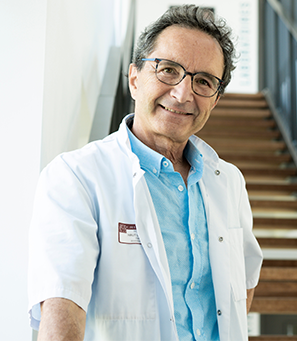
Michel Haïssaguerre was born in Bayonne, in the French Basque Country. Appointed professor of cardiology in 1994, he works at the Haut-Lévêque cardiology hospital and the University of Bordeaux.
His scientific and clinical work focuses primarily on cardiac electrophysiology and arrhythmias. He is particularly recognized for his remarkable contributions in the field of cardiac fibrillations (atrial and ventricular fibrillation), the most devastating cardiac arrhythmias. He has demonstrated that these arrhythmias, described for decades as diffuse and chaotic circular activities (reentries, Garrey, Mines 1914) actually originate from localized sources.
Atrial fibrillation (AF) is the most common human arrhythmia and a major cause of embolic strokes. He demonstrated that the reentries considered to be the cause of AF were in fact the result of ultra-rapid focal activities generated outside the heart, in the vascular walls of the pulmonary veins, which were believed to be electrically inert. He proposed a catheter ablation technique to eliminate these foci, which is now the standard curative treatment worldwide. AF ablation is now the most commonly performed electrophysiology procedure, with the number of patients treated (1 million in 2023) growing each year.
Ventricular fibrillation (VF) is a major cause of sudden cardiac death, accounting for ≈10% of total mortality in adults worldwide. He demonstrated that AF was generated from focal sources, particularly from ventricular Purkinje cells (a tiny part of the myocardial mass) or individual myocardial areas in patients with structural heart disease. As with AF, he demonstrated that localized ventricular ablation was curative.
Michel Haïssaguerre has published over 1,000 articles in leading medical journals, mainly on the pathophysiology, mapping, and treatment of cardiac arrhythmias.
He enjoys an exceptional scientific reputation. He has received prestigious awards such as the Nylin Swedish Prize (2002), the Grüntzig Best Scientist Award (2003, European Society of Cardiology), the Pioneer in Cardiac Electrophysiology award (2004, North American Society of Pacing and Electrophysiology (NASPE, now the Heart Rhythm Society), and the Mirowski Award in 2009. In 2010, he received the Lefoulon Delalande Prize (Institut de France), the Louis Jeantet Prize for Medicine, and in 2014 became a member of the French Academy of Sciences and of Academy of Medicine. In 2015, the European Society of Cardiology awarded him the ESC Gold Medal for his outstanding work in the field of cardiology and electrophysiology. In the 2020s, he received numerous awards from national or continental cardiology societies.
In 2012, following an international competition organized by the French government, he created a unique institute dedicated to basic cardiac electrophysiology and modeling, the LIRYC, which welcomes 150 people from many nationalities.
Winner of an ERC Advanced Grant in 2021, he is currently working on a project (HELP) which aims to address the major challenge of identifying people at risk and preventing sudden cardiac death caused by ventricular arrhythmias.